
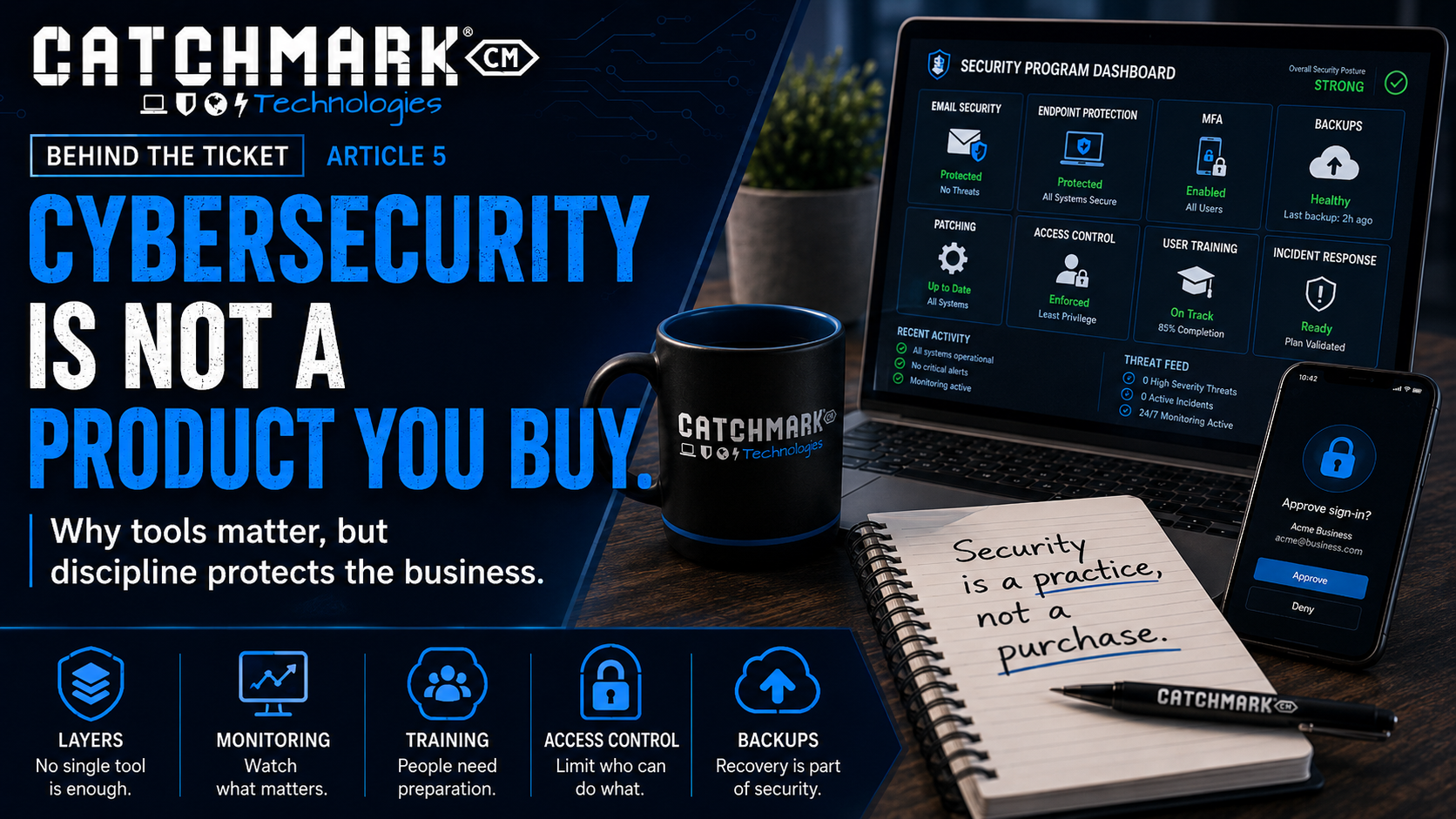
Why tools matter, but discipline protects the business.
Every IT ticket tells a story.
Sometimes the story starts with a question.
“We bought antivirus. Are we covered?”
“We have a firewall. Isn’t that enough?”
“Our email has spam filtering, so why did this message get through?”
“We use Microsoft 365. Doesn’t that handle security?”
“Our insurance company is asking about security tools. Can we just check the box?”
On the surface, these sound like technology questions.
They sound like questions about products.
What do we own?
What have we installed?
What are we paying for?
What box can we check?
But cybersecurity does not work that way.
A tool can help protect a business.
A product can reduce risk.
A platform can provide important security features.
But cybersecurity is not something you simply buy, install, and forget.
Cybersecurity is a practice.
It is a discipline.
It is a set of decisions, habits, tools, processes, expectations, and follow-through that work together over time.
The ticket may say, “Do we have security software?”
But behind the ticket, the better question is, “Are we actually managing security?”
The Ticket
“We bought cybersecurity software, so are we protected?”
This is one of the most common misunderstandings in small business technology.
A business buys antivirus, endpoint protection, email filtering, a firewall, backup software, or a security awareness training platform. Then, understandably, leadership feels like the security concern has been addressed.
The purchase creates confidence.
But confidence is only useful when it is connected to reality.
Buying a security tool is not the same as having a security program.
It is like buying a gym membership and assuming you are now in shape.
The membership may give you access to what you need, but it does not do the work for you. Someone still has to show up, follow a plan, build habits, measure progress, and stay consistent.
Cybersecurity works the same way.
The tool matters.
But the discipline matters more.
What It Looks Like
Cybersecurity can look deceptively simple from the outside.
There is antivirus on the computers.
There is a firewall in the building.
There is spam filtering on email.
There are backups running somewhere.
There is MFA on some accounts.
There is a policy saved in a folder.
There may even be a training platform that sends employees occasional phishing tests.
Each of those things may be useful.
But useful is not the same as complete.
The question is not just whether the business has security tools.
The better questions are:
Are they configured correctly?
Are alerts being reviewed?
Are updates being applied?
Are exceptions being documented?
Are users being trained?
Are backups being tested?
Are accounts being reviewed?
Are former employees being removed?
Are risky behaviors being corrected?
Are leaders following the same standards as everyone else?
Are incidents being discussed and improved from?
Security fails when businesses confuse ownership with management.
Having the tool is only the beginning.
What Might Really Be Happening
When a business assumes cybersecurity is handled because it bought a product, several things may be happening beneath the surface.
Alerts may be going unread.
Devices may be missing protection.
Security tools may be installed but misconfigured.
Backups may be running but never tested.
MFA may be enabled for some users but not all.
Admin accounts may have more access than they need.
Former employees may still have active credentials.
Employees may be clicking links without understanding the risk.
Vendors may have access that no one reviews.
Policies may exist but not be followed.
No one may know exactly what would happen if an incident occurred.
These are not always dramatic failures.
Most of the time, they are quiet gaps.
That is what makes them dangerous.
Cybersecurity problems often build quietly until one bad moment exposes all of the weak spots at once.
Tools Are Necessary, But Not Sufficient
A business does need security tools.
This is not an argument against technology.
Modern organizations need layers of protection. They need endpoint security. They need email protection. They need firewalls. They need backups. They need MFA. They need monitoring. They need filtering. They need logging. They need secure configurations.
The right tools matter.
But tools do not replace judgment.
They do not replace accountability.
They do not replace training.
They do not replace policy.
They do not replace leadership.
They do not replace a plan.
A firewall does not help much if remote access is poorly configured.
Antivirus does not eliminate the risk of a stolen password.
A backup system does not matter if no one verifies that data can be restored.
MFA does not protect accounts where it is not enabled.
Security awareness training does not help if leaders excuse risky behavior.
A policy does not protect the business if no one follows it.
Cybersecurity is not about one layer.
It is about layers working together.
False Confidence Is a Risk
One of the biggest dangers in cybersecurity is false confidence.
False confidence happens when a business believes it is more secure than it actually is.
It often comes from good intentions.
The business made an investment.
A vendor said the product was strong.
A dashboard shows green checkmarks.
A report says threats were blocked.
An insurance questionnaire was completed.
Nothing bad has happened yet.
So leadership assumes the organization is protected.
But “nothing bad has happened” is not the same as “we are prepared.”
A business can go a long time with weak security and no visible incident.
That does not mean the risk is low.
It may simply mean the business has not been tested yet.
Good security leadership does not ask, “Have we been lucky so far?”
It asks, “Are we ready if luck runs out?”
Cybersecurity Is Operational
The best way for business leaders to think about cybersecurity is not as a product category.
It is an operational discipline.
Just like finance, HR, safety, quality, and customer service, cybersecurity has to become part of how the business operates.
That means there should be expectations.
There should be standards.
There should be ownership.
There should be review.
There should be follow-through.
There should be consequences for ignoring the basics.
Employees should know what to do with suspicious emails.
Managers should know how access is approved.
Leadership should know which systems matter most.
IT should know what devices exist.
The business should know whether backups can restore.
Everyone should know that security is not optional when it is inconvenient.
This is where a Managed Service Provider can provide real value.
An MSP does not just provide tools.
A strong MSP helps bring security into the operating rhythm of the business.
What a Strong MSP Brings to Cybersecurity
A good MSP helps translate cybersecurity from a technical concept into practical business protection.
That includes tools, but it also includes structure.
It includes making sure devices are monitored.
It includes reviewing alerts.
It includes helping manage patches.
It includes supporting MFA.
It includes helping standardize user access.
It includes protecting endpoints.
It includes helping secure email.
It includes monitoring backups.
It includes documenting systems.
It includes coordinating vendors.
It includes helping leadership understand risk.
It includes explaining what matters most and what can wait.
For many small and mid-sized businesses, this is difficult to replicate internally without significant investment.
Cybersecurity requires technical knowledge, tools, time, process, and ongoing attention.
It is not one person checking a box once a year.
It is a continuous effort.
An MSP gives the business access to resources, tools, knowledge, and responsiveness that would often cost much more to build alone.
The Human Layer
Most cybersecurity conversations eventually come back to people.
People click links.
People reuse passwords.
People approve access.
People ignore updates.
People make exceptions.
People get busy.
People get tired.
People trust messages that look familiar.
People assume someone else is watching.
That does not mean people are the problem.
It means people are part of the system.
A good security approach does not shame employees for being human.
It builds guardrails around human behavior.
Training helps.
Clear expectations help.
MFA helps.
Password managers help.
Approval processes help.
Least privilege access helps.
Good communication helps.
Leadership consistency helps.
The goal is not to make every employee a cybersecurity expert.
The goal is to create an environment where doing the secure thing is normal, expected, and supported.
Backups Are Security Too
Many businesses think of backups as an IT operations issue.
They are.
But they are also a cybersecurity issue.
If ransomware hits, if a file is deleted, if a system is compromised, or if data is corrupted, the ability to restore matters.
A backup is not just a technical convenience.
It is part of business resilience.
But once again, owning a backup product is not enough.
Are backups running?
Are they monitored?
Are failures addressed?
Is the right data included?
How long is data retained?
Who can access the backup system?
Has a restore been tested?
How long would recovery take?
What systems would come back first?
The worst time to learn that a backup does not work is during an emergency.
Good IT does not assume backups are fine.
Good IT verifies.
Insurance Has Changed the Conversation
Cyber insurance has forced many businesses to look more closely at security.
Insurance applications increasingly ask about MFA, backups, endpoint protection, access control, security awareness training, patching, and incident response.
That can be helpful because it pushes security into leadership conversations.
But there is also a risk.
Businesses may start treating cybersecurity as a questionnaire instead of a responsibility.
The goal should not be to answer the insurance questions in the easiest possible way.
The goal should be to understand why those questions are being asked.
Insurance companies ask about MFA because compromised credentials are a serious risk.
They ask about backups because recovery matters.
They ask about security tools because prevention and detection matter.
They ask about policies because accountability matters.
They ask about response plans because confusion during an incident makes damage worse.
The questionnaire is not the point.
The business risk behind the question is the point.
What Good Cybersecurity Looks Like
Good cybersecurity is not panic.
It is not fear.
It is not buying every tool a vendor recommends.
It is not making the business impossible to operate.
Good cybersecurity is thoughtful, layered, and practical.
It looks like MFA on important accounts.
It looks like employees who know how to report suspicious messages.
It looks like endpoint protection that is monitored.
It looks like backups that are tested.
It looks like systems that are patched.
It looks like access that is reviewed.
It looks like former employees being removed quickly.
It looks like admin rights being limited.
It looks like vendors being managed.
It looks like leaders asking better questions.
It looks like an MSP helping the business understand where to focus.
The goal is not perfect security.
Perfect security does not exist.
The goal is better security, better readiness, and better decisions.
The Better Question
Instead of asking, “What security product should we buy?”
Leaders should ask, “How are we managing cybersecurity as part of the business?”
That question changes the conversation.
It moves the focus from a purchase to a practice.
It moves the focus from tools to outcomes.
It moves the focus from checkboxes to accountability.
It moves the focus from fear to readiness.
A business does not need to become paranoid.
But it does need to become responsible.
That means understanding that cybersecurity is not something separate from the business.
It is part of how the business protects its people, customers, data, reputation, and ability to operate.
The Leadership Lesson
Cybersecurity is not a product you buy.
It is a responsibility you manage.
Tools are important. They create layers of protection. They help detect problems. They reduce risk. They make the business more resilient.
But tools do not lead.
People do.
A strong MSP can bring the tools, knowledge, processes, responsiveness, and guidance needed to help protect the business. But leadership still has to care. Leadership still has to support the standards. Leadership still has to treat security as part of how the organization operates.
The businesses that do this well are not the ones that buy one product and hope.
They are the ones that build habits, create expectations, ask better questions, and stay consistent.
The ticket matters.
But when it comes to cybersecurity, what happens before the ticket may be what keeps the business from becoming the next incident.
Facebook • Instagram • YouTube • TikTok • LinkedIn • X
Stay connected to what’s happening in our area by visiting CatchMark Community or what is going on in the world of local sports with CatchMark SportsNet.
Powered by CatchMark Technologies — helping people, solving problems. Explore more on our website