
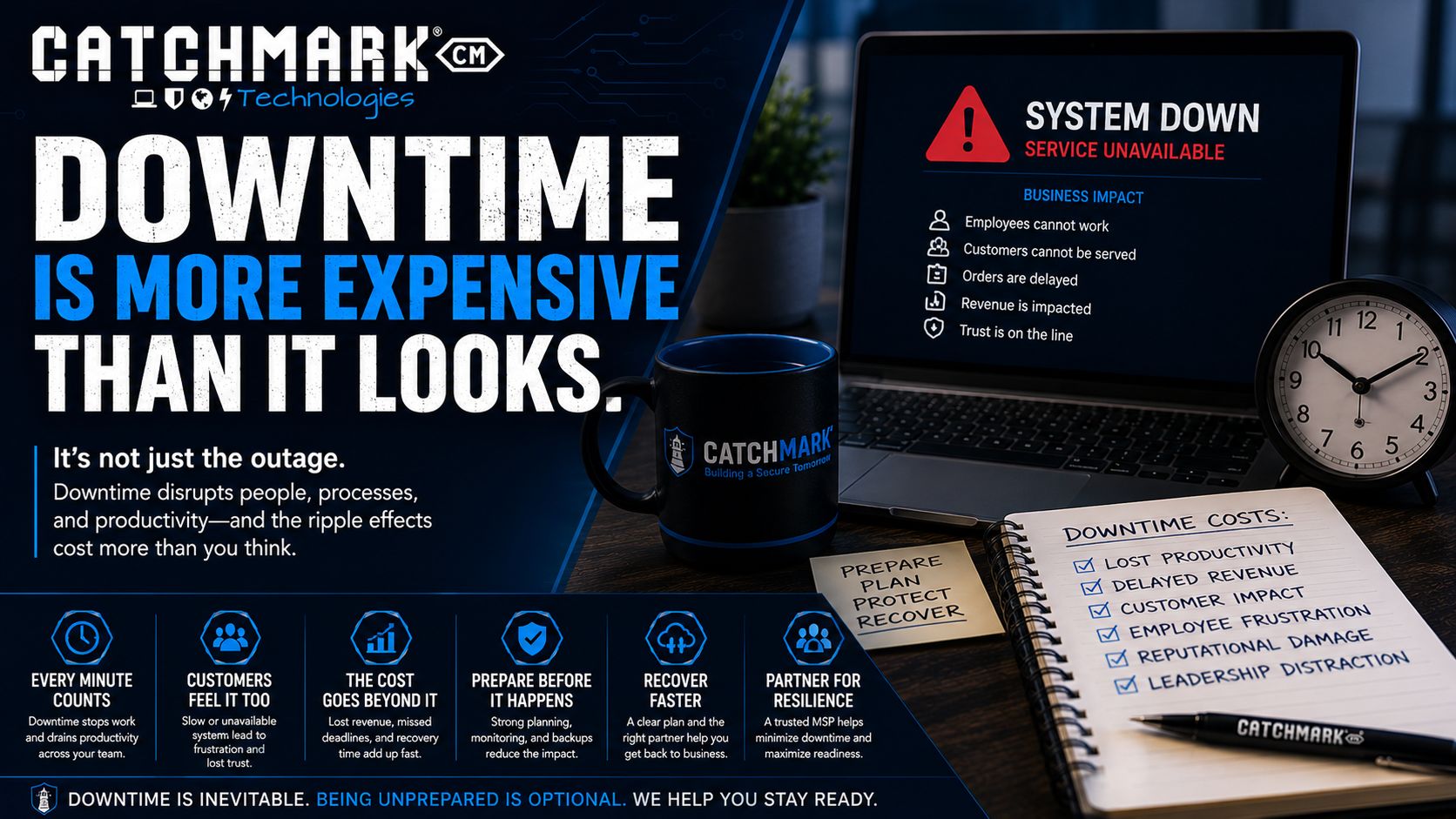
Why “it was only down for an hour” is rarely that simple.
Every IT ticket tells a story.
Sometimes the story starts with urgency.
“The internet is down.”
“Email is not working.”
“We cannot access the system.”
“The phones are offline.”
“The server is not responding.”
“No one can print.”
“Our payment system is down.”
“The application we use every day will not load.”
On the surface, these sound like technology problems.
Something is unavailable.
Something needs to be fixed.
Someone needs to respond.
But downtime is rarely just about the system that stopped working.
Downtime affects people.
It affects customers.
It affects schedules, billing, communication, production, service delivery, trust, morale, and leadership focus.
The ticket may say, “system down.”
But behind the ticket, the real issue is business interruption.
The Ticket
“The system was only down for an hour.”
That sentence sounds reasonable.
An hour does not seem catastrophic. It is not a full day. It is not a week. It may not even feel like enough time to justify a major conversation.
But the cost of downtime is not measured only by the length of the outage.
It is measured by what could not happen during that time.
How many employees were affected?
Could customers reach you?
Could invoices be sent?
Could payments be processed?
Could orders be entered?
Could appointments be scheduled?
Could production continue?
Could leadership focus on anything else?
Could employees do meaningful work, or were they waiting, refreshing, guessing, and working around the problem?
An hour of downtime for one person is an inconvenience.
An hour of downtime across an entire organization is something else entirely.
What It Looks Like
Downtime often looks smaller than it really is.
To one person, it may look like email not loading.
To another, it may look like a customer waiting on hold.
To the finance team, it may look like billing delays.
To the sales team, it may look like lost momentum.
To operations, it may look like work stopping.
To leadership, it may look like everyone asking the same question at the same time.
“Is it fixed yet?”
The visible issue may be technical, but the ripple effect is operational.
People stop what they are doing.
They check with coworkers.
They try to figure out if the problem is just them.
They restart devices.
They call support.
They message managers.
They look for workarounds.
They delay decisions.
They lose focus.
Even after the system comes back online, the disruption continues.
People have to restart tasks, catch up on missed work, respond to delayed customers, recreate lost momentum, and restore confidence.
That is why downtime is rarely limited to the outage window.
The interruption begins before the issue is fully understood and continues after the system is restored.
What Might Really Be Happening
When downtime happens, the immediate question is usually, “What broke?”
That matters.
But after the immediate issue is addressed, leaders should ask a deeper question.
“Why did this interruption have this much impact?”
The answer may reveal larger problems.
Maybe there was no backup internet connection.
Maybe the business relied on one aging server.
Maybe a critical system had no redundancy.
Maybe no one knew who to call.
Maybe vendor responsibilities were unclear.
Maybe the outage was caused by neglected maintenance.
Maybe employees had no documented workaround.
Maybe cloud services were assumed to be always available.
Maybe the business had never discussed recovery priorities.
Maybe the company did not know which systems were most critical until one went down.
These are not just technical issues.
They are planning issues.
Downtime exposes how prepared, or unprepared, the business really is.
Downtime Has Direct Costs
Some downtime costs are easy to understand.
If employees cannot work, there is labor cost.
If customers cannot buy, there is revenue impact.
If production stops, there is operational cost.
If deadlines are missed, there may be penalties, delays, or damaged relationships.
If systems are down long enough, there may even be contractual, compliance, or service-level consequences.
These costs are real.
But they are only part of the picture.
The harder costs to measure are often the ones that matter most over time.
Customer frustration.
Employee stress.
Lost confidence.
Reputational damage.
Delayed decisions.
Interrupted momentum.
Leadership distraction.
Workarounds that create new problems.
Downtime does not just stop technology.
It slows the business.
The Productivity Cost Adds Up Quickly
Imagine ten employees lose access to the system they need for one hour.
That is ten hours of lost productivity before you account for the time spent troubleshooting, communicating, restarting work, and catching up.
Now imagine twenty employees.
Or fifty.
Now imagine the outage happens during billing, payroll, customer service, shipping, registration, scheduling, production, or a major deadline.
The same one-hour outage can have very different consequences depending on when it happens, who it affects, and what business process depends on the system.
This is why downtime should not be evaluated only by duration.
Impact matters more than clock time.
A short outage at the wrong moment can be more damaging than a longer outage during a quiet period.
Good IT does not simply ask, “How long was it down?”
Good IT asks, “What did the outage interrupt?”
Downtime Creates Workarounds
When systems are unavailable, people try to keep moving.
That instinct is good. Employees want to serve customers and get work done.
But workarounds can create risk.
Files get saved locally.
Information gets written on paper.
Customer requests get tracked in personal notes.
Payments are delayed or
Facebook • Instagram • YouTube • TikTok • LinkedIn • X
Stay connected to what’s happening in our area by visiting CatchMark Community or what is going on in the world of local sports with CatchMark SportsNet.
Powered by CatchMark Technologies — helping people, solving problems. Explore more on our website