Your business probably has cybersecurity. You have a firewall. Antivirus is running. Employees use passwords. Maybe you’ve rolled out multi-factor authentication. Someone is handling backups. When something needs to change, your IT team takes care of it.
So you’re covered…right?
Now imagine tomorrow morning you need to answer a few questions:
- Who has administrator access to your systems?
- Is MFA protecting every account that should have it?
- What changed on your network in the last six months—and who approved those changes?
- If an employee leaves today, exactly what access needs to be removed?
- If your systems go down, which ones need to come back first?
Those questions are harder. That’s the difference between having cybersecurity tools and having a functioning cybersecurity program.
The good news? You don’t have to fix everything overnight. You need to know where you’re starting.
What Is a Functioning Cybersecurity Program?
A cybersecurity program connects the technology you already use with the people, documentation, policies, and processes needed to protect it.
For some organizations, that program may also need to align with established cybersecurity frameworks or regulatory requirements. The NIST Cybersecurity Framework can provide structure for managing cybersecurity risk, while businesses handling protected health information may also need to address HIPAA security requirements. Other organizations may have industry, customer, insurance, or contractual cybersecurity requirements they need to consider.
But whether you’re working toward NIST alignment, HIPAA compliance, or simply trying to strengthen your organization’s cybersecurity practices, the starting point is similar.
And surprisingly, the first step isn’t buying another security product. It’s figuring out what you already have.
That means documenting devices, software, cloud services, network equipment, user accounts, vendors, administrative access, critical systems, and where important information lives.
Once you can see the environment, you can start asking better questions.
Who actually needs administrator privileges? Where should MFA be required? Are old accounts still active? Are backups working? Who can make significant changes to the network?
From there, businesses can begin putting structure around cybersecurity.
A change management process, for example, creates a documented way to review significant technology changes before they happen. Some organizations may establish a Change Management Board to determine what is changing, why it’s changing, what risks are involved, and who approved it.
Policies can then establish expectations for things like:
- User access and permissions
- Multi-factor authentication
- Administrative accounts
- Employee on boarding and off boarding
- Password and account security
- Change management
- Data protection
- Backup and recovery
- Incident response
- Vendor and third-party access
- Patch and vulnerability management
But there’s an important catch.
Writing the policy doesn’t mean you’ve solved the problem.
The policy has to become something the business actually does.
The Business Takeaway: Build a Program That Works
Cybersecurity can feel overwhelming. Businesses are presented with long lists of requirements, vulnerabilities, controls, policies, and compliance standards, making it seem like the goal is to become 100% compliant.
But that’s not where most businesses need to start.
The better first goal is building a cybersecurity program that functions in the real world.
If your policy requires MFA, it should actually be enabled. If administrative access is restricted, permissions should be regularly reviewed. When an employee leaves, there should be a reliable process for removing access. Backups shouldn’t just exist—they should be tested. And significant technology changes should be documented and approved rather than living in someone’s memory.
That’s how cybersecurity moves from a checklist to an operating process:
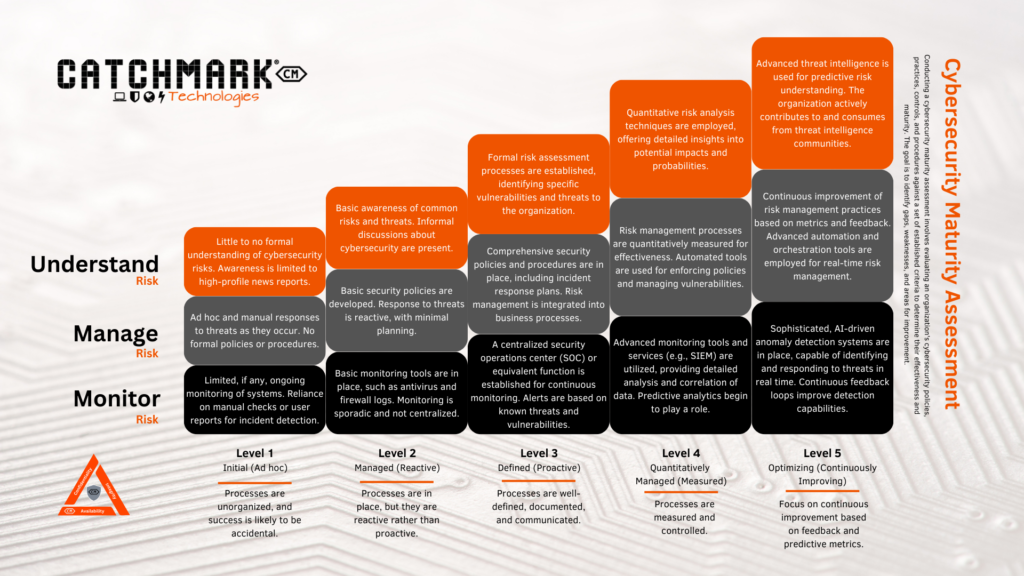
Understand what you have → Control changes → Establish policies → Implement them → Monitor and improve.
This becomes especially important as a business grows. Employees come and go. New computers are purchased. Software and cloud applications are added. Vendors receive access. Networks change. Each decision adds another piece to an environment that can become difficult to see as a whole.
You don’t have to solve every cybersecurity issue at once. But you should be able to answer some important questions:
Who has access to your most important systems? Is MFA protecting the accounts that need it? Who can make changes to your environment? What happens to access when an employee leaves? Are your backups recoverable? And does everyone know what to do if something goes wrong?
If you’re unsure about some of those answers, that’s a good place to start.
CatchMark Technologies can help you establish a clear picture of where your cybersecurity program stands today. We’ll work with you to document your environment, identify gaps, establish practical policies and processes, and turn those decisions into security practices your organization can actually follow.
You don’t need another cybersecurity checklist. You need to know where you stand and what to do next.
Contact CatchMark Technologies to start with a cybersecurity assessment and begin building a security program that works for your business.
Follow CatchMark on Facebook and LinkedIn to see what we’re working on and learn more about how we help businesses solve everyday technology problems.