
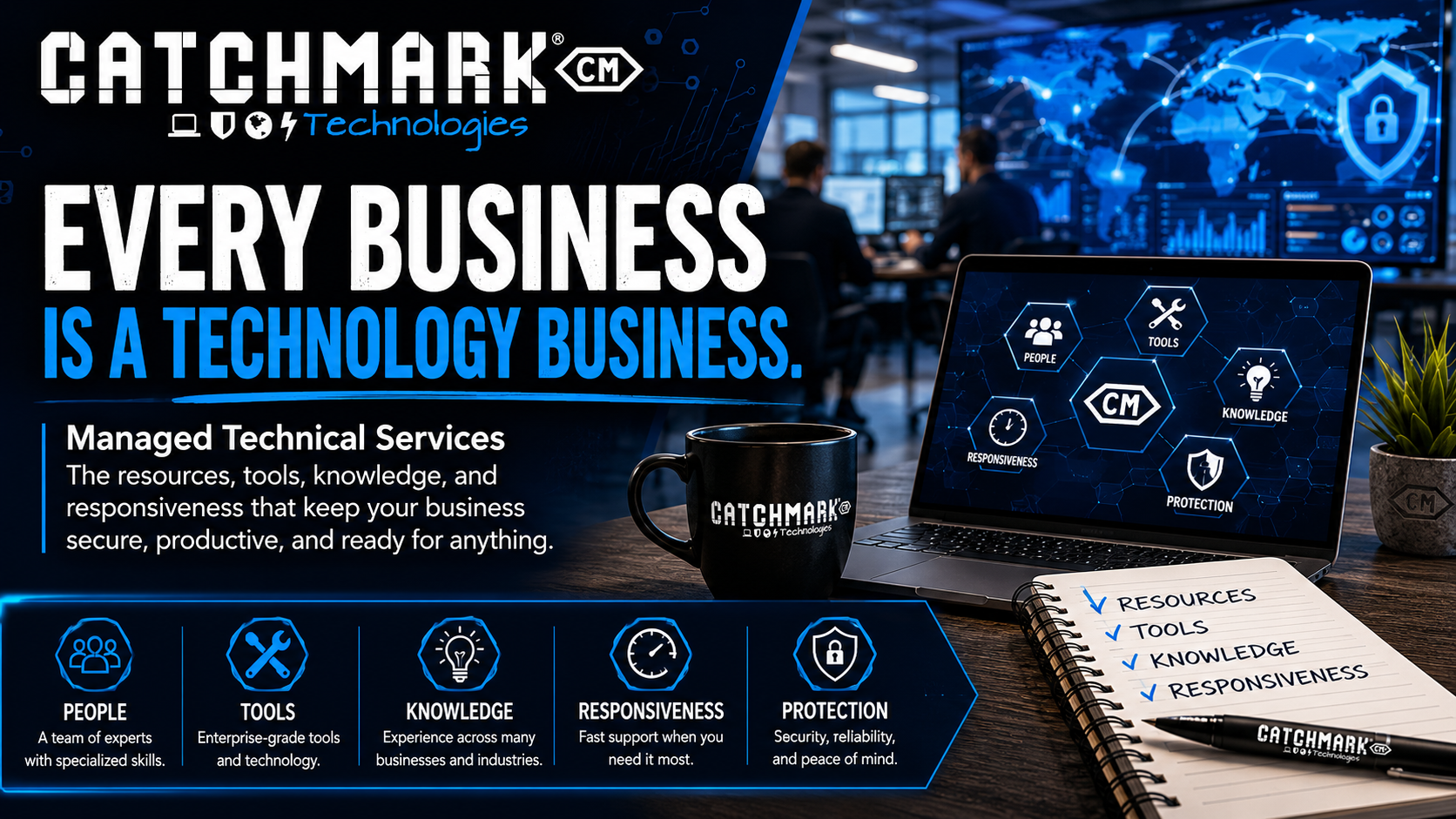
What small business leaders should know about IT before something breaks.
Every IT ticket tells a story.
Sometimes the story is simple.
A password needs to be reset.
A printer stops working.
A laptop is running slow.
A file will not open.
An employee cannot access email.
On the surface, those issues can feel small. Annoying, maybe. Disruptive, definitely. But still small.
Until you step back and look at what they really mean.
That password problem may be slowing down a customer response.
That printer issue may be holding up billing.
That slow laptop may be draining productivity every single day.
That file access issue may be revealing a deeper problem with permissions, security, or process.
That email outage may be stopping the business from communicating with customers, vendors, and employees.
The ticket is not always the real issue.
Often, the ticket is the moment when a business realizes just how dependent it is on technology.
And that is the first lesson of this series.
Every business is now a technology business.
You May Not Sell Technology, But You Run On It
Most small businesses do not think of themselves as technology companies.
A manufacturer makes products.
A law firm provides legal guidance.
A medical office cares for patients.
A nonprofit serves its community.
A construction company builds things.
A local retailer sells goods.
A school educates students.
A financial firm manages money.
But every one of those organizations relies on technology to operate.
They use technology to communicate, schedule, invoice, quote, process payments, manage customer relationships, protect records, store documents, track inventory, run payroll, manage vendors, advertise services, and make decisions.
Even businesses that feel hands-on, local, traditional, or relationship-driven are deeply dependent on technology.
When the technology works, no one thinks much about it.
When it fails, everything gets harder.
That is why IT can no longer be treated like a side issue, a necessary annoyance, or something to deal with only when something breaks.
Technology is now part of the operating system of the business itself.
The Old View of IT Is Too Small
For years, many small businesses thought about IT in a very limited way.
IT was the person you called when the computer broke.
IT fixed the printer.
IT reset the password.
IT helped install software.
IT showed up when something stopped working.
That kind of support still matters. Responsive help desk service is important. People need help when they are stuck, and businesses need someone who can solve those problems quickly.
But modern IT is much bigger than break-fix support.
Today, technology affects almost every serious business concern.
Security.
Productivity.
Compliance.
Insurance.
Customer experience.
Employee satisfaction.
Business continuity.
Vendor management.
Data protection.
Strategic planning.
This is why the conversation has shifted from simple technical support to managed technical services.
A good Managed Service Provider, or MSP, is not just waiting for things to break.
A good MSP is helping manage the technology environment so the business can operate more securely, more efficiently, and with more confidence.
What Are Managed Technical Services?
Managed technical services are the ongoing management, support, monitoring, protection, and improvement of a business’s technology environment.
In plain language, it means a business has a team responsible for helping keep its technology working, secure, documented, monitored, and aligned with the needs of the organization.
This can include help desk support, device management, cybersecurity tools, backup monitoring, Microsoft 365 management, network support, vendor coordination, software updates, security awareness, strategic planning, reporting, and long-term technology guidance.
But the real value is not just the list of services.
The real value is ownership.
Someone is watching the environment.
Someone is responding when employees need help.
Someone is reviewing risk.
Someone is thinking about security.
Someone is checking backups.
Someone is maintaining documentation.
Someone is helping plan replacements and improvements.
Someone is connecting technology decisions to business outcomes.
That is the difference between having “someone who fixes computers” and having a managed technology partner.
One reacts to problems.
The other helps reduce them.
Why Businesses Struggle To Replicate This Internally
Some business owners ask a fair question.
Why not just hire someone internally?
In some cases, that can make sense. Larger organizations may need internal IT leadership or dedicated technical staff. But for many small and mid-sized businesses, building the same level of coverage internally is difficult and expensive.
The reason is simple.
Modern IT requires more than one person.
It requires a range of skills, tools, systems, processes, and availability that are hard to replicate with a single hire.
One person may be great at desktop support but not cybersecurity.
Another may understand networking but not Microsoft 365 administration.
Someone may be good with people but weak on documentation.
Someone may be strong technically but unavailable when they are on vacation, sick, in a meeting, working on another issue, or already overloaded.
That does not mean internal IT people are not valuable. Many are excellent. But the needs of a modern business are broad.
Technology now requires depth and coverage.
An MSP gives a business access to a larger bench.
What a Customer Gets From an MSP
A strong MSP gives a business much more than technical support.
It provides resources that would be expensive to build internally and difficult to maintain consistently.
A Team Instead of One Person
With an MSP, a business gets access to multiple people with different strengths.
Help desk technicians.
System administrators.
Network specialists.
Cybersecurity professionals.
Project engineers.
Strategic advisors.
Vendor managers.
Technical leaders.
That matters because not every problem is the same.
A password reset, firewall issue, email migration, security alert, backup failure, and strategic planning conversation all require different skills.
A good MSP brings the right resource to the right problem.
Professional Tools
Strong IT management requires tools.
Monitoring tools.
Remote support tools.
Endpoint protection.
Backup systems.
Ticketing systems.
Documentation platforms.
Patch management.
Security awareness tools.
Reporting systems.
Asset tracking.
Email security.
Network visibility.
These tools are not just convenient. They are part of how technology is managed professionally.
For many businesses, purchasing, configuring, maintaining, and properly using these tools internally would cost far more than working with an MSP.
The tool itself is not enough. Someone also has to know how to use it, monitor it, respond to it, and make decisions from it.
Broader Knowledge
An MSP sees patterns across many environments.
That is a major advantage.
When you support multiple businesses, you begin to recognize common risks, recurring issues, vendor problems, security trends, aging equipment patterns, user training gaps, and operational weaknesses.
That experience matters.
It helps an MSP identify problems faster, recommend better solutions, and guide clients away from mistakes they have already seen elsewhere.
A single business may only experience a certain problem once.
An MSP may have helped solve that same problem dozens of times.
Responsiveness and Coverage
Technology problems do not always arrive at convenient times.
Employees need help during busy parts of the day. Systems fail when deadlines are approaching. Security alerts require attention. Vendors need coordination. Projects need planning. Updates need management.
An MSP provides a level of responsiveness and coverage that is hard for many businesses to create internally.
This does not mean every issue is instant or every request has the same urgency. Good IT still requires prioritization.
But it does mean there is a system in place.
There is a ticketing process.
There is a support team.
There are escalation paths.
There is accountability.
There is documentation.
There is visibility.
That structure matters.
Standards and Process
One of the most overlooked values of an MSP is standardization.
Without standards, technology environments become messy over time.
Different devices.
Different software versions.
Different security settings.
Different purchasing decisions.
Different account practices.
Different vendors.
Different ways of doing the same thing.
At first, inconsistency feels flexible.
Facebook • Instagram • YouTube • TikTok • LinkedIn • X
Stay connected to what’s happening in our area by visiting CatchMark Community or what is going on in the world of local sports with CatchMark SportsNet.
Powered by CatchMark Technologies — helping people, solving problems. Explore more on our website