
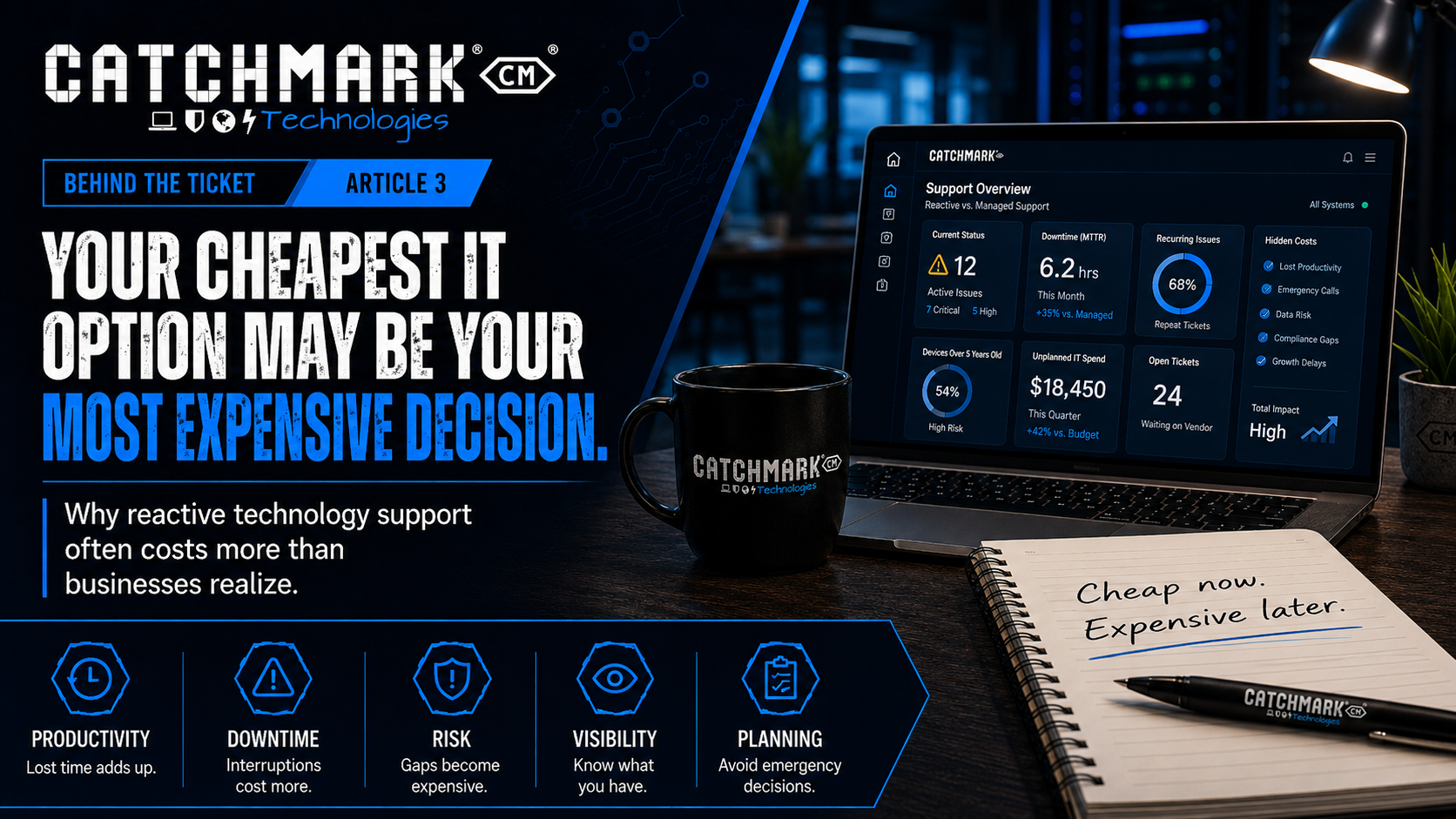
Why reactive technology support often costs more than businesses realize.
Every IT ticket tells a story.
Sometimes the story sounds simple.
A computer stopped working.
A user cannot access a system.
A backup did not run.
A vendor needs technical information.
A new employee needs to be set up.
A former employee still has access to something they should not.
On the surface, these look like individual technology problems.
But many times, they are really signs of a larger issue.
The business has been operating without a real technology plan.
That is where cheap IT becomes expensive.
Not always immediately. Not always visibly. But eventually.
Because when technology is treated as something to deal with only after it breaks, the business usually pays for it later in downtime, frustration, security risk, lost productivity, emergency decisions, and missed opportunities.
The ticket is not always the problem.
Sometimes the ticket is the invoice finally coming due for years of underinvestment.
The Ticket
“We only call someone when something breaks.”
For many small businesses, this has been the traditional IT model.
Something stops working, so someone gets called.
Maybe it is a local technician. Maybe it is someone’s cousin who is good with computers. Maybe it is a vendor who helps occasionally. Maybe it is an internal employee who knows just enough to keep things moving.
And to be fair, this approach can feel practical at first.
Why pay for ongoing support if there are not many issues?
Why invest in monitoring if things seem fine?
Why standardize equipment if the current computers still turn on?
Why document systems if everyone mostly knows how things work?
Why improve security if nothing bad has happened yet?
That thinking is understandable.
It is also risky.
Break-fix IT feels cheaper because you are only paying when there is a visible problem.
But the real cost of technology problems is rarely limited to the repair bill.
What It Looks Like
At first, reactive IT can appear to work.
The business has a problem. Someone fixes it. The business moves on.
A laptop fails, so a replacement is purchased.
A password issue comes up, so it gets reset.
A printer stops working, so someone reconnects it.
A software issue appears, so a vendor is contacted.
A network problem happens, so someone comes onsite.
Each issue gets handled one at a time.
But over time, patterns begin to show.
The same issues keep coming back.
Employees lose time waiting for help.
Systems become inconsistent.
New devices are purchased without a standard.
Licenses are added without tracking.
Old users remain in systems.
No one is completely sure where important credentials are stored.
Backups are assumed to be working, but rarely tested.
Security tools are installed, but not actively reviewed.
Documentation exists in someone’s head, not in a system.
The business keeps functioning, but the environment slowly gets messier.
And messy technology is expensive technology.
What Might Really Be Happening
The real issue is not that the business had a computer problem.
The real issue is that there may be no structure underneath the technology environment.
No consistent standards.
No lifecycle planning.
No monitoring.
No clear documentation.
No regular security review.
No patch management process.
No centralized inventory.
No clear onboarding or offboarding process.
No defined ownership.
No strategic technology roadmap.
That does not always create an immediate crisis.
It creates drift.
Technology drift happens slowly. A decision gets made here. An exception gets made there. A device gets added. A license gets purchased. A password gets shared. A former employee’s account gets left active. A backup fails quietly. A firewall ages past its useful life. A server keeps running because replacing it would be inconvenient.
None of those decisions may feel significant in the moment.
Together, they create risk.
The business may think it is saving money, but often it is just delaying cost.
Cheap Is Not the Same as Cost-Effective
There is nothing wrong with being cost-conscious.
Business leaders should care about spending wisely. Technology investments should make sense. Not every company needs the most expensive tools, the most complex systems, or an oversized IT budget.
But there is a big difference between being cost-effective and being cheap.
Cost-effective means you are getting appropriate value for what the business actually needs.
Cheap means you are reducing spending without fully understanding what risk or inefficiency you are accepting.
That distinction matters.
A cost-effective IT strategy helps the business operate securely, productively, and predictably.
A cheap IT approach often leaves the business exposed, inconsistent, and reactive.
The lowest-cost option may look attractive on paper.
But if it increases downtime, frustrates employees, weakens security, delays response, creates confusion, or causes emergency spending later, it was not really the cheapest option.
It was just the cheapest invoice.
The Hidden Costs of Reactive IT
Reactive IT creates costs that do not always show up as technology expenses.
They show up in the business.
Lost Productivity
When employees cannot work, the business pays for it.
A slow computer may seem like a small issue, but small delays compound. Five minutes here. Ten minutes there. A system restart. A login issue. A file that will not sync. A printer that fails again.
Multiply that across employees, weeks, and months, and the cost becomes real.
Productivity loss is one of the easiest technology costs to underestimate because it rarely arrives as a separate bill.
It appears as frustration, delay, lower output, and wasted attention.
Downtime
Downtime is expensive because it stops more than computers.
It stops communication.
It stops billing.
It stops scheduling.
It stops service.
It stops production.
It stops customers from getting what they need.
Even a short outage can create a ripple effect across the business.
The repair may cost one amount.
The interruption costs much more.
Emergency Decisions
Reactive businesses often make technology decisions under pressure.
A server fails, so something has to be replaced immediately.
A laptop dies, so someone buys whatever is available.
A vendor issue escalates, so the business accepts a quick fix.
A security concern appears, so tools are purchased in a rush.
Emergency decisions are rarely the best decisions.
They are usually more expensive, less thoughtful, and harder to integrate into a long-term plan.
Security Risk
Cybersecurity is one of the clearest examples of why reactive IT is dangerous.
You cannot secure a business effectively only after something goes wrong.
By then, the damage may already be done.
Security requires layers, monitoring, policies, updates, training, access control, backups, and response planning.
A business that only thinks about security after a suspicious email, compromised account, ransomware event, or insurance questionnaire is already behind.
Security is not something to bolt on during a crisis.
It has to be built into the way technology is managed.
Employee Frustration
People want to do good work.
When technology constantly gets in their way, frustration builds.
Employees may stop reporting problems because they assume nothing will change.
They may create workarounds.
They may store files in the wrong place.
They may use personal tools.
They may share passwords.
They may avoid systems that are too slow or unreliable.
These behaviors are not always signs of careless employees.
Sometimes they are signs of a technology environment that has not been managed well.
Poor IT creates poor habits.
Lack of Visibility
One of the biggest risks in a reactive environment is that leadership may not actually know what is happening.
What devices do we own?
Which ones are aging out?
Who has access to what?
Are backups working?
Are updates current?
Which systems are business-critical?
Where are the biggest risks?
What would happen if a key person left?
What would happen if the internet went down?
What would happen if Microsoft 365 access was compromised?
Without visibility, leaders are making decisions with incomplete information.
That is not just an IT problem.
That is a leadership problem.
Why Managed Technical Services Are Different
Managed technical services are designed to move a business away from constant reaction.
That does not mean nothing ever breaks.
Things still happen. Devices fail. Users need help. Vendors have issues. Software changes. Cyber threats evolve.
But the overall approach is different.
Instead of asking, “Who do we call when this breaks?”
The business begins asking, “How do we manage this environment so fewer things break, risks are reduced, and the business is better prepared?”
That is the value of a strong MSP.
It brings structure.
It brings tools.
It brings process.
It brings documentation.
It brings monitoring.
It brings accountability.
It brings a team.
Most small businesses would struggle to build all of that internally without spending significantly more.
A single internal person may be valuable, but one person cannot easily replicate the depth of a full MSP team, the tool stack, the escalation structure, the cross-client experience, and the ongoing operational discipline that managed services provide.
What Good IT Looks Like
Good IT does not simply respond to problems.
It manages the environment.
That means devices are tracked.
Systems are monitored.
Security tools are reviewed.
Backups are checked.
Patches are managed.
Licenses are organized.
Documentation is maintained.
Users are onboarded and offboarded properly.
Standards are created.
Vendors are coordinated.
Recurring issues are analyzed.
Recommendations are made before emergencies happen.
A good MSP should help business leaders understand what they have, where the risks are, what needs attention, and what should be planned next.
This is where the value shifts.
The MSP is not just fixing technology.
It is helping manage business risk.
The Better Question
The question is not, “What is the cheapest way to get IT help?”
The better question is, “What level of technology management does this business need to operate securely and effectively?”
Those are very different questions.
The first question focuses on price.
The second focuses on value.
The first question looks at the next invoice.
The second looks at the health of the business.
The first question assumes technology is a support function.
The second recognizes that technology is part of how the business operates.
That shift matters.
Because if every business is now a technology business, then technology cannot be managed as an afterthought.
When Cheap IT Becomes Expensive
Cheap IT becomes expensive when the business loses time.
It becomes expensive when employees are frustrated.
It becomes expensive when systems are unreliable.
It becomes expensive when security gaps are ignored.
It becomes expensive when leadership lacks visibility.
It becomes expensive when no one knows how things are configured.
It becomes expensive when backups fail.
It becomes expensive when a former employee still has access.
It becomes expensive when the business has to pay emergency rates for problems that could have been planned for.
It becomes expensive when customers are impacted.
It becomes expensive when trust is damaged.
The true cost of IT is not just what you pay the provider.
It is what the business experiences because of how technology is managed.
The Leadership Lesson
The cheapest IT option is not always the least expensive.
Sometimes it is just the option that delays the real cost until the worst possible moment.
Strong technology management does not eliminate every problem, but it does reduce unnecessary risk. It gives leaders visibility. It gives employees support. It creates standards. It improves readiness. It helps the business make better decisions before pressure takes over.
That is what managed technical services are really about.
Not more complexity.
Not more tools for the sake of tools.
Not technology theater.
Managed technical services are about helping the business operate with less disruption, less risk, and more confidence.
The ticket matters.
But what the ticket reveals about how the business has been managing technology matters even more.
Facebook • Instagram • YouTube • TikTok • LinkedIn • X
Stay connected to what’s happening in our area by visiting CatchMark Community or what is going on in the world of local sports with CatchMark SportsNet.
Powered by CatchMark Technologies — helping people, solving problems. Explore more on our website