The company had done the work. Cybersecurity policies were written, expectations were documented, and a Change Control Board was established to review important technology changes.
Then someone asked a simple question:
“Is MFA actually turned on for everyone?”
No one was completely sure.
That question exposed a common gap in cybersecurity programs: Writing the policy and implementing the policy are two very different things.
The Policy Is Just the Starting Point
Documentation creates the rules for how your business should protect its systems and data. Frameworks such as the NIST Cybersecurity Framework, along with requirements such as HIPAA for applicable organizations, can help define those expectations.
But a policy requiring multi-factor authentication doesn’t mean MFA is enabled. A backup policy doesn’t mean your backups can actually be restored. An offboarding policy doesn’t guarantee a former employee’s access was removed.
Implementation is where you turn “this is what we should do” into “this is what we actually do.”
Turn Policies Into Actions
Start by looking at what each policy requires in the real world.
If your policy requires MFA, confirm which accounts have it enabled. If administrative access should be limited, review who currently has those permissions. If backups are required, make sure they’re running and test whether they can be restored. If employee access should be removed at termination, make sure HR and IT have a clear process for making that happen.
You may uncover a long list of improvements. That doesn’t mean everything needs to be fixed at once. Prioritize based on risk, starting with the gaps that could have the greatest impact on your business.
Use Change Control to Implement Safely
Implementing cybersecurity policies often means changing systems, configurations, permissions, and processes. That’s where your Change Control Board becomes important.
Before making a significant change, understand what’s changing, why it’s necessary, what could be affected, who approved it, and what happens if something goes wrong.
Change control isn’t about slowing down IT. It’s about making changes intentionally so fixing one problem doesn’t create another.
Don’t Stop at “Implemented”
Once a security control is in place, make sure it actually works.
If backups are running, test a restore. If former employee accounts should be disabled, review your accounts. If MFA is required, confirm it’s enabled everywhere it should be.
You can apply the same simple test to almost any cybersecurity policy:
Are we doing it? How do we know? Can we prove it?
If you can’t confidently answer those questions, you’ve identified an area of your cybersecurity program that may need attention.
From Policy to Protection
Cybersecurity isn’t finished when the policies are approved. That’s when the next phase begins.
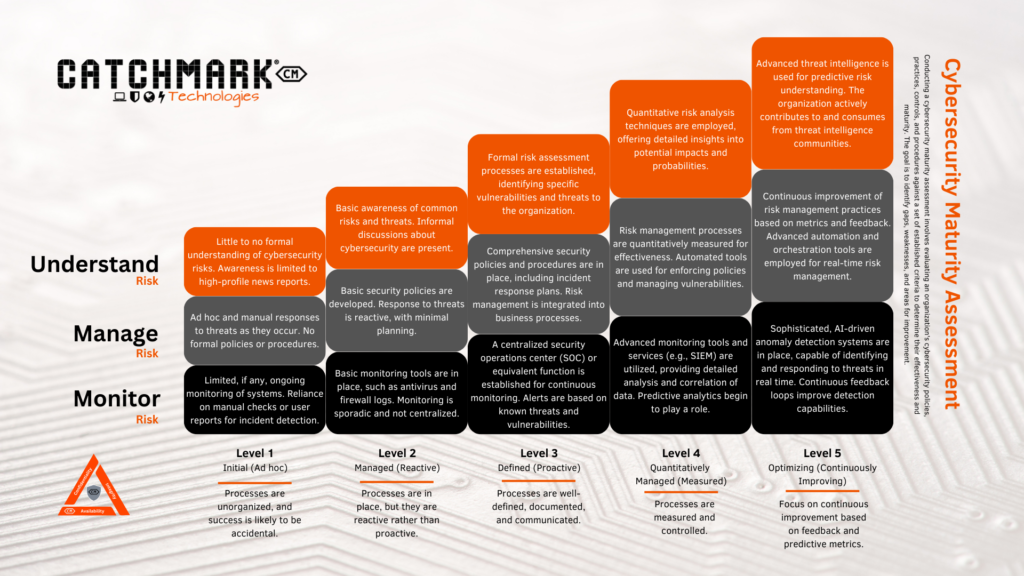
Document expectations → Prioritize risk → Implement protections → Verify they work → Continue improving.
You don’t need to fix everything at once. You need a process that steadily turns written policies into real protections for your business.
Where Does Your Cybersecurity Program Stand?
You may have policies in place. You may have already implemented some cybersecurity protections. But do you know where your program stands today — and where the biggest gaps may still exist?
Reach out to CatchMark Technologies for a free cybersecurity audit. We’ll help you take a look at your current cybersecurity program, identify potential gaps, and understand what your next steps should be.
Your policies created the roadmap. Let’s make sure your cybersecurity program is putting it into action.
Follow CatchMark on Facebook and LinkedIn to see what we’re working on and learn more about how we help businesses solve everyday technology problems.